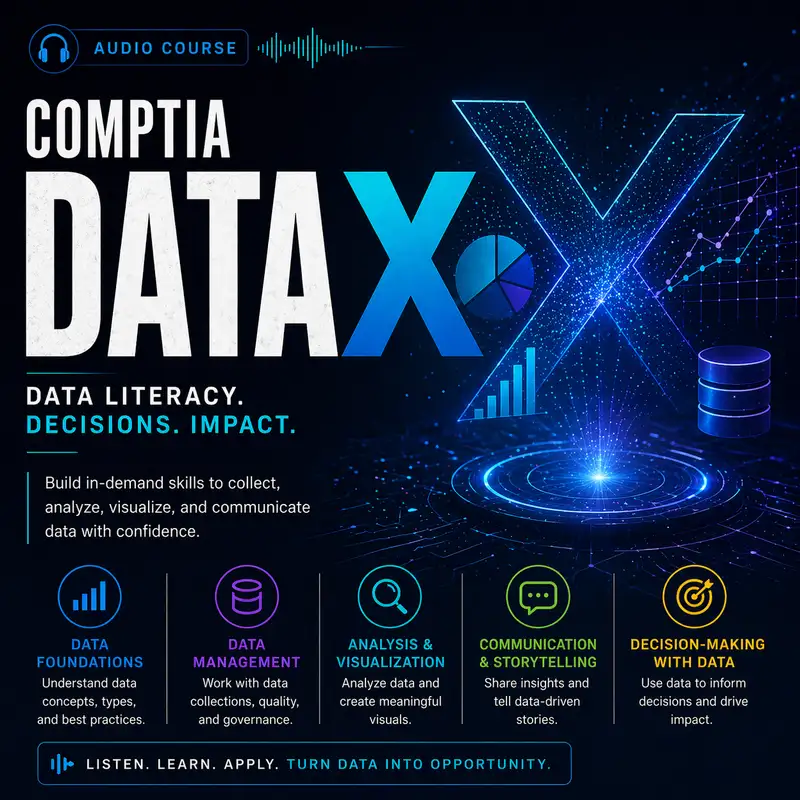
Episode 1 — Welcome to DataX DY0-001 and How This Audio Course Works
In Episode One, titled “Welcome to Data X D Y zero dash zero zero one and How This Audio Course Works,” we set expectations for what this audio course will feel like, how it will flow, and what “exam readiness” means in practice. The promise here is not hype, and it is not vague encouragement, but a steady approach that trains you to recognize what a question is really asking and to choose the best answer consistently. In a certification exam, confidence is usually the byproduct of repeated correct decisions, not the result of a single inspiring study session. That is why the structure you are about to hear is designed around recall, decision-making, and reinforcement rather than around long lectures that are easy to understand and easy to forget. If you stick with the flow, the payoff is that the exam starts to feel like familiar terrain instead of a long hallway of surprises.
Before we continue, a quick note: this audio course is a companion to the Data X books. The first book is about the exam and provides detailed information on how to pass it best. The second book is a Kindle-only eBook that contains 1,000 flashcards that can be used on your mobile device or Kindle. Check them both out at Cyber Author dot me, in the Bare Metal Study Guides Series.
To understand the scope of Data X, it helps to treat the exam like a map rather than a pile of facts. The CompTIA organization is not only testing whether you can define terms, but whether you can recognize which competency applies when the situation is messy, time is limited, and several answers sound reasonable. Data X, as an exam, sits at the intersection of data handling, governance, analysis thinking, and security-minded decision making, with a practical emphasis on how data moves through real environments. You can think of the scope as covering what data is, how it is collected and prepared, how it is interpreted, and how it is protected and managed throughout its lifecycle. The competencies are not isolated, because in real work the choice you make about quality, access, retention, or privacy changes the value of the analysis and the risk exposure at the same time.
When CompTIA designs an exam like this, they expect mastery that goes beyond recognition and reaches application. That means you should be able to distinguish between similar concepts, understand tradeoffs, and pick a course of action that fits constraints rather than an idealized textbook world. In practice, you will be expected to understand the difference between data that is merely present and data that is trustworthy, between access that is convenient and access that is appropriate, and between a metric that is visible and a metric that is meaningful. You should also be ready to think about data as an asset that must be governed, not just as raw material for dashboards. If you have a background in cybersecurity, you already know the feeling of being tested on judgment, where the “best” answer is the one that reduces risk while meeting business needs, not the one that sounds the most technical.
This course is built to strengthen recall by tying ideas to stories and decisions, because that is how your brain retrieves information under pressure. A list of definitions can be learned quickly and lost quickly, but a repeated pattern of context, signal, constraint, and choice tends to stick. In each episode, you will hear concepts explained in plain language, followed by realistic framing that forces a decision, followed by a reinforcement loop that calls out why one choice is better than the others. That style is not accidental, because most exam questions are not asking, “What is the definition,” but rather, “Given this situation, what should be done,” or “Which interpretation is most accurate.” When you learn through decisions, you are practicing the same mental motion the exam requires, which is identifying what matters, ignoring what does not, and selecting the best answer without second guessing yourself into a hole.
A weekly listening rhythm matters more than people want to admit, because consistency is what converts knowledge into reflex. If you listen in large, irregular bursts, you may feel productive, but your recall will often decay before you return to the topic. The better model is steady exposure, where you revisit ideas often enough that they remain available in working memory when you need them. Short reviews are the secret weapon in an audio-first format, because they take advantage of spacing and retrieval rather than sheer volume. You want the pattern where you can summarize what you just learned in your own words, hear the idea again from a slightly different angle, and then recognize it later without effort. When you do that week after week, the exam stops feeling like a test of memory and starts feeling like a test of recognizing familiar decision points.
A key reason this approach works is that scenario thinking is built into how most exam questions are written. The majority of higher-quality questions begin with context, because context forces you to choose which concept applies and which details are irrelevant. You will hear prompts that sound like a realistic workplace moment, because that is the natural container for tradeoffs like accuracy versus timeliness, access versus control, and insight versus privacy. In those scenarios, the challenge is rarely a single concept in isolation; the challenge is selecting what you do first, what you do next, and what you avoid because it creates risk or wastes time. If you have ever done incident response, you already understand this rhythm: you gather signal, respect constraints, and take the smallest step that increases certainty. Data X scenarios ask for that same professional mindset, even when the domain is data and analytics rather than a breach.
Because the questions rely on nuanced wording, vocabulary discipline becomes a practical skill, not an academic one. The rule we will follow is simple: when an unfamiliar term appears, it gets defined briefly in plain language, and then it gets used in context so it stops being abstract. The goal is not to bury you in jargon, but also not to dodge the language the exam will use. Many learners fail exams not because they are incapable, but because they misread a term, confuse two adjacent concepts, or assume a word means what it meant in their last job. Here, we’ll treat vocabulary as a set of handles you can grab quickly, and we will keep definitions tight enough to be useful without turning every concept into a long detour. Over time, you should notice that the words feel less like obstacles and more like signals that point to the right family of answers.
To make those signals easier to retrieve, we will use memory anchors, which are short phrases that trigger the right mental checklist. A memory anchor is not a gimmick, and it is not a slogan you repeat for motivation; it is a compact cue that reminds you what matters in a decision. For example, in security you might use an anchor like “least privilege, then monitor,” because it compresses a strategy into a phrase that guides choices. In this course, memory anchors will often connect a scenario to a priority order, such as validating data quality before trusting a model output, or confirming governance rules before expanding access. The benefit is speed: when you hear the scenario, the anchor appears in your mind, and you move toward the best answer rather than getting pulled into distractors that sound attractive but violate a core principle.
It is also important to be honest about what audio cannot do, because pretending otherwise wastes your time. Audio cannot replace hands-on practice, and it cannot simulate the tactile learning that happens when you work with tools, data sets, or environments directly. What audio can do, and what it does extremely well, is train recognition, sharpen judgment, and build a reliable decision framework that transfers into hands-on work. In other words, audio is excellent for building the mental model that tells you what you should try and why, even if the mechanical steps are learned elsewhere. For many learners, the missing ingredient is not effort but structure, because they have touched many topics but have not built a coherent way to choose under exam pressure. This course replaces that gap with repeated decision training, so your hands-on practice becomes more purposeful and your exam answers become more consistent.
To turn listening into self-testing, you will hear a method that uses pauses and spoken multiple choice prompts as a built-in checkpoint. The idea is to create moments where you commit to an answer before you hear the explanation, because committing is what reveals whether you truly understood the concept. Passive listening can feel comfortable while hiding weak spots, but active recall makes weak spots visible immediately. When you make a choice, even silently, your brain is doing the same work it must do on the exam, which is selecting an option from several plausible candidates. Then, when the explanation arrives, it either reinforces correct thinking or corrects a misconception before it gets reinforced through repetition. Over time, you should notice that you begin predicting the correct answer earlier, because the pattern becomes familiar and your decision speed improves.
Once you have a way to self-test, you need a simple way to track weak areas without turning your life into a complicated study administration project. The goal is quick, repeatable notes that capture what you missed and why, so you can revisit the precise edge where your understanding failed. A weak area is rarely “the whole topic,” and it is usually a specific confusion, such as mixing up two terms, ignoring a constraint, or choosing an answer that is technically true but not the best fit for the scenario. Your notes should capture that confusion in a short phrase you can review later, because the purpose is to trigger corrective recall, not to produce a perfect set of study materials. When the same confusion shows up more than once, you have identified a pattern worth fixing, and patterns are exactly what the exam is built to exploit.
As we move forward, it helps to preview domain coverage so you understand the journey and can recognize milestones as you go. Data X coverage will move through core concepts of data and its lifecycle, the thinking required to interpret and communicate results, and the governance and security considerations that keep data valuable and safe. You will also encounter patterns around quality, ethics, privacy, and operational constraints, because modern data work is inseparable from risk management and responsible handling. The milestones are not just chapters completed, but competencies gained, such as the ability to interpret a question stem quickly, identify what is being tested, and eliminate distractors with confidence. When you know the shape of the journey, it becomes easier to trust the process, because you can feel yourself building a toolkit rather than collecting trivia. That sense of direction matters on days when your motivation is low, because you can still see progress in the form of stronger recall and faster decisions.
Along the way, you will also hear mixed review episodes that combine concepts into exam patterns, because the exam rarely respects the boundaries of neat categories. Mixed reviews are where learners often level up, because they stop relying on recognition and start relying on reasoning. When a question blends data quality with governance, or interpretation with privacy constraints, you have to decide which principle dominates the choice, and that is exactly where many test takers hesitate. The purpose of mixing is not to confuse you, but to make sure your knowledge is connected and flexible rather than compartmentalized. When concepts are woven together, your brain learns to retrieve them as a network, which is closer to how real problems work and closer to how exam questions are designed. By the time you reach those mixed reviews, you should find that the scenarios feel familiar, even when the surface details change.
Motivation is worth addressing directly, not because you need cheerleading, but because timed pressure changes how people think. Under time constraints, people tend to second guess, overread, and chase perfect certainty, which is a trap on most certification exams. Steady listening builds confidence by turning decision making into a practiced routine rather than an emotional event, and that routine is what shows up when the clock is running. Confidence is not arrogance; it is the ability to choose a defensible answer and move on, trusting that the pattern you learned is reliable. If you have a job, a family, or both, your study time is precious, and the most realistic plan is the one you can repeat even on imperfect days. Over time, that repeatable rhythm creates a kind of calm competence, where the exam feels demanding but not overwhelming.
To close Episode One, we will transition you toward Episode Two with a clear next step and a single goal for today that keeps momentum without requiring a major schedule overhaul. The next episode will begin building the foundational mental models you will use repeatedly, and you will start hearing the decision patterns that make multiple choice questions feel less like guesswork and more like structured reasoning. For today, the goal is straightforward: commit to a consistent listening window you can actually keep, even if it is short, and treat it as a professional appointment with your future self. When you do that, you are not relying on motivation spikes, you are building a routine that carries you through the full scope of the exam. Start Episode Two when you are ready, and carry forward the simple intention of showing up consistently, because consistency is what turns knowledge into exam-ready judgment.